Two oral drugs, each aimed at a different inflammatory route, could reach the IL-22-associated inflammation that remains in atopic dermatitis when a single treatment is not enough.
Atopic dermatitis is a chronic skin disease driven by several interleukins at once (signalling molecules that immune cells pass to one another): IL-4 and IL-13 on one side, IL-22 and related cytokines on another. Some patients do not respond sufficiently to the systemic treatments in use, and for them inflammation and itch continue.
The question AI3 Discovery set out to answer was this: can a drug that removes the end protein of the IL-4/IL-13 route and a second drug chosen for the IL-22 route be given complementary jobs, and is there a pair that fits?
Why it is hard today
Injectable antibodies block IL-4 and IL-13 signalling. Oral JAK1 inhibitors, upadacitinib and abrocitinib, are approved by the US FDA and in use. Each reaches only part of the signalling network, and the record names three places where they run out.
- Signal the antibody leaves behind. After three months of dupilumab, the effect on IL-22-related pathways was reported to be limited.
- A gap in the combination evidence. Public reports centre on single-drug treatment, one drug at a time.
- Difficulty of choosing the partner. Of five JAK inhibitors tested, only one reduced IL-22-induced viral susceptibility, so picking a second drug is not a matter of taking any JAK inhibitor.
For clinicians and developers this means no clear next option for patients whom a single drug does not control.
Where the idea came from
The starting point was the observation that IL-4/IL-13 and IL-22 reach the skin cell by different routes. If that is so, a drug that removes the end protein of the first route leaves the second route running, and a second drug aimed at the second route could add something.
Two sets of evidence made the idea worth testing. The first is a comparison of JAK inhibitors. Arnold 2023 tested five of them in a model in which cytokines raise the susceptibility of skin cells to viral infection. Only deucravacitinib reduced the susceptibility raised by IL-22, by 76 ± 19% in viral plaque counts.
The second is the development stage of the two drugs. The STAT6 degrader KT-621 has reached phase 2. The TYK2 inhibitor deucravacitinib is approved for psoriasis. Both are oral small molecules with human exposure behind them.
The closest earlier work already goes part of the way. Reports on IL-22 in atopic dermatitis and on single-drug treatment exist, and one earlier source lists more than a thousand co-administered agents, in which the two drugs appear only as separate entries. The earlier work AI3 Discovery reviewed did not identify KT-621 and deucravacitinib as a pair for atopic dermatitis.
How AI3 Discovery tested it
AI3 Discovery did the analysis on BioQ, its bio research platform that holds 97 public biological databases, each checked against its original, indexed and cross-linked by identifier. For this study AI3 Discovery drew mainly on ClinicalTrials.gov (registered clinical trials), ChEMBL (measured drug–target activity), GTEx (gene expression and its genetic control in normal tissues), IMPC and MGI (mouse model phenotypes), Open Targets (target–disease evidence and drug development stages), the GWAS Catalog (genetic associations with traits and diseases), the Human Protein Atlas (where proteins and RNA are found in tissues and cells), and FAERS with drug warnings (adverse-event signals). AI3 Discovery compared several ideas against the data. The routes that failed are part of the result.
| Idea | Test | Result |
|---|---|---|
| Thyroid axis of JAK1 as the lead | GTEx thyroid eQTL, GWAS direction | Not supported: nominal association only |
| Patient selection by IL-22 alone | Earlier reports on IL-22 and IL-22RA1 antibody | Not supported as new: already public |
| The two signals use different routes | Pathway gene lists for both routes | Supported: 104 and 19 unique genes |
| TYK2 is absent from the IL-4/IL-13 side | Interaction-network neighbours of TYK2 | Not supported: TYK2–STAT6 score 964 |
| IL-22 receptor is present in keratinocytes | Human Protein Atlas, 154 cell types | Supported at low level: IL22RA1 2.1–6.6 ncpm |
| The pair has been assessed together | ClinicalTrials.gov title query | Open: no trial names both in its title |
Routes dropped. AI3 Discovery dropped the thyroid axis. It had examined JAK1 thyroid eQTLs (genetic variants that change expression in a tissue) and the risk allele, and the support did not reach beyond a GTEx association at nominal level and an agreeing GWAS direction. The literature also already reports thyroid assessment under JAK inhibitors. AI3 Discovery set aside patient selection as a standalone idea too: the rise of IL-22 in atopic dermatitis and monotherapy results with an IL-22RA1-blocking antibody are already public, so a selection marker alone is not new. The reviewed material contained no combination assessment: zero cases.
Two routes. Pathway gene lists hold 111 genes for IL-4/IL-13 signalling and 26 for IL-20 family signalling. Seven are shared, including TYK2, JAK1 and STAT3. That leaves 104 genes unique to the first route and 19 to the second. STAT6 sits only on the first list. IL22 and IL22RA1 sit only on the second.
TYK2 is not exclusive to IL-22. In the interaction network, IL22RA1 connects to JAK1 at 986, to TYK2 at 927 and to STAT3 at 945. TYK2, however, also connects to IL13RA1 at 998, to STAT6 at 964 and to IL4R at 902. TYK2 sits in both gene lists. What separates the routes is STAT6 on one side and the IL-22 members on the other. For that reason AI3 Discovery does not state that TYK2 is unrelated to the IL-4/IL-13 side.
Skin cells. In Human Protein Atlas release 25.1, basal and suprabasal keratinocytes carry STAT6 at 52.0 and 57.5 normalised counts per million (ncpm), TYK2 at 9.4 and 12.4, STAT3 at 192.8 and 220.9, and IL22RA1 at 2.1 and 6.6. IL22 RNA expression in T cells is 50.4 ncpm. A cell type counts as detecting a gene at 1 ncpm or more: IL22RA1 is above zero in 103 of 154 cell types and at 1 or more in 44. The TYK2 and STAT3 values were new compared with the earlier research notes.
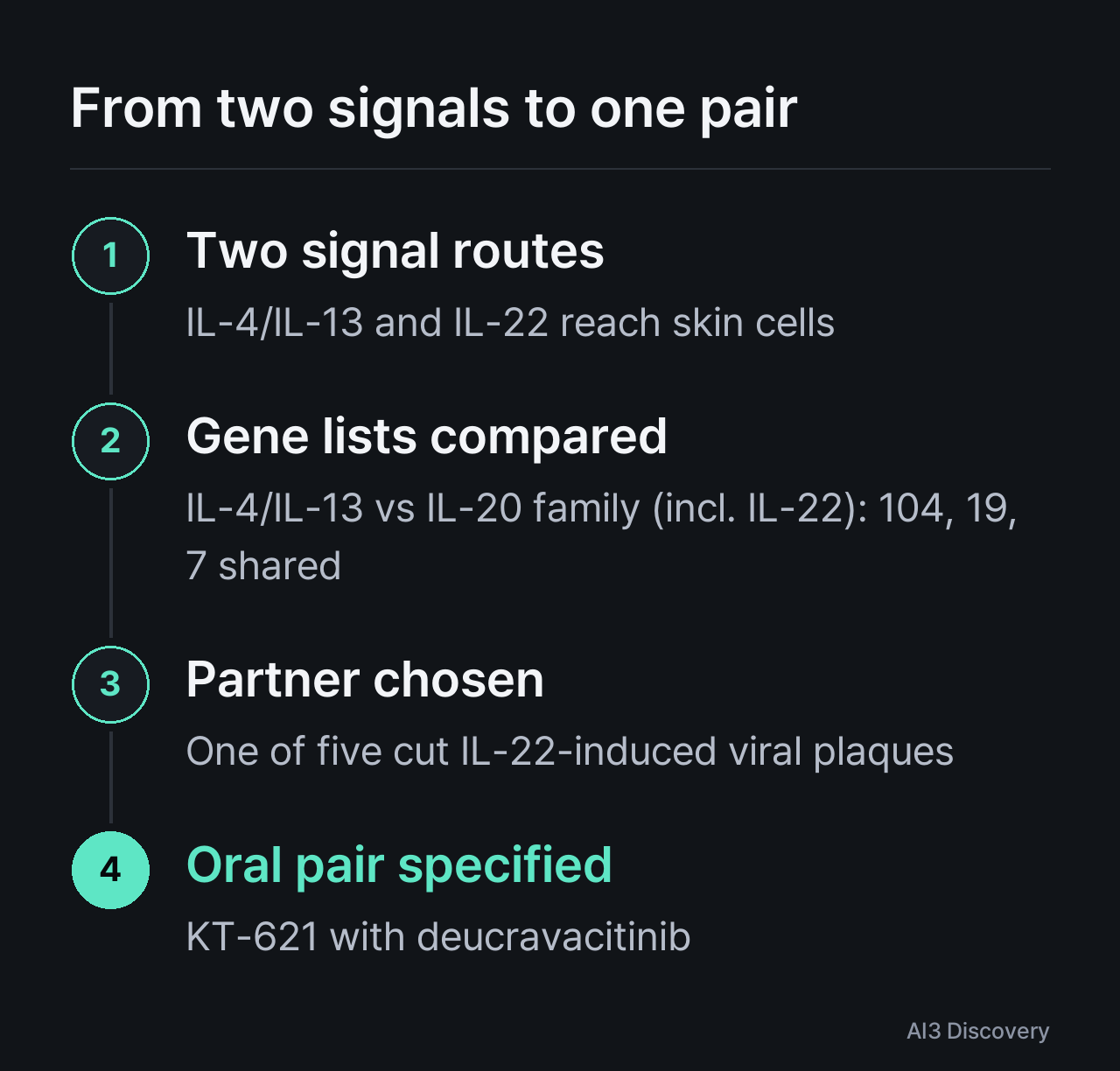
Figure 1. From two signals to one pair. How AI3 Discovery moved from two inflammatory routes to a specified drug pair.
What AI3 Discovery found
AI3 Discovery specified a combination for atopic dermatitis made of two oral small molecules: the STAT6 degrader KT-621, which lowers the STAT6 protein, and the TYK2 inhibitor deucravacitinib, which blocks the TYK2 enzyme. The first is assigned to the IL-4/IL-13 route. The second is assigned to the IL-22 route.
How the second drug was chosen. The rule was narrow. The partner had to be a drug that reduced IL-22-induced viral plaque counts in the five-inhibitor comparison. One of five did, deucravacitinib. In the same comparison AI3 Discovery found no basis to choose any other JAK inhibitor for the IL-22 role.
Deucravacitinib in the data. Its ChEMBL entry is CHEMBL4435170, and the FDA approval date is 2022-09-09. It acts as a negative allosteric modulator, that is, it binds outside the active site and switches the enzyme off. In Open Targets, atopic eczema is one of 30 listed indications and sits at the UNKNOWN development stage. ClinicalTrials.gov lists 52 deucravacitinib trials, only one with an atopic condition (NCT07352566, a small phase 4 study). KT-621 has six registered trials, all by its developer and none with posted results. The query found no registered trial with both drugs in its title. The association of TYK2 with atopic eczema in Open Targets scores 0.595, and STAT6 scores 0.4734.
What is new. Four parts make up the invention.
- The two named drugs are specified as one combination pair for atopic dermatitis.
- Earlier work mentions them only as separate items in a list of over a thousand co-administered agents.
- An assay evaluates the added effect of the TYK2 inhibitor alongside the degrader.
- A method uses IL-22 axis markers to provide information on whether a patient is a suitable candidate for the combination.
What AI3 Discovery found. AI3 Discovery analysed the IL-4/IL-13 and IL-22 signalling routes on BioQ and specified a pair for atopic dermatitis: the STAT6 degrader KT-621 for the first route and the TYK2 inhibitor deucravacitinib for the second. What is new: The closest earlier work tests single drugs or lists co-administered agents; the earlier work AI3 Discovery reviewed did not identify KT-621 and deucravacitinib as a pair for atopic dermatitis.
How it works
In a keratinocyte, IL-4 and IL-13 signal through a receptor, JAK kinases and the transcription factor STAT6. IL-22 signals through IL22RA1, JAK1 and TYK2 and then STAT3. A degrader removes the STAT6 protein itself, so the first route should be silenced at its end point. A TYK2 inhibitor blocks an enzyme on the second route. The hypothesis is complementary targeting of two routes that only partly overlap.
The chain the idea expects is this: STAT6 falls and the IL-4/IL-13 output falls; TYK2 is blocked and the IL-22 output falls; and the skin inflammation arriving by the two routes falls together.
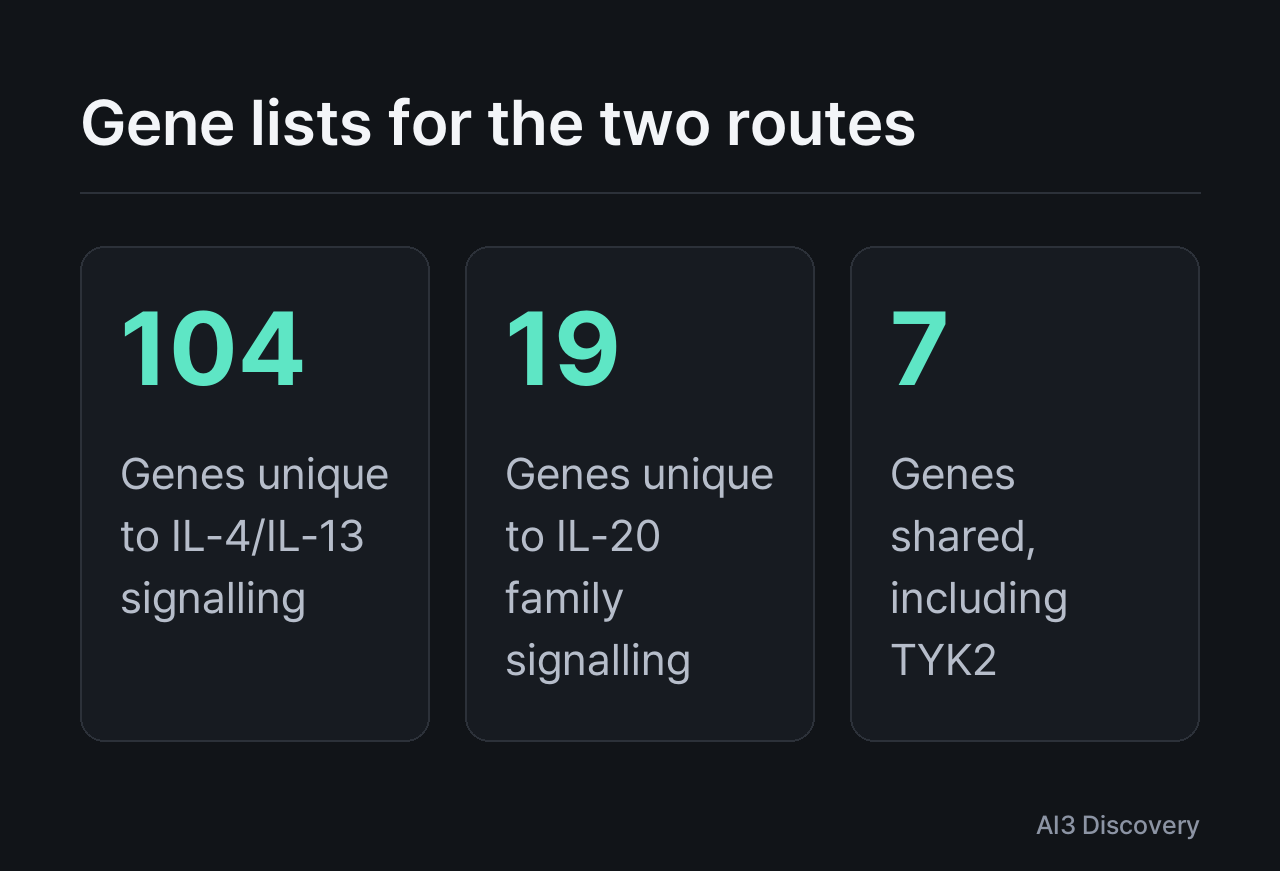
Figure 2. Gene lists for the two routes. The two routes share few genes, but TYK2 is one of them.
What the evidence shows - and what it does not
The evidence is a calculation on public data and one earlier comparison. It supports the design. It does not show that the combination works.
- The routes overlap. The gene lists share seven genes, TYK2 among them, and TYK2 is strongly linked to STAT6 and IL13RA1 in the interaction network. The premise that the two drugs do not overlap is therefore an assumption to be tested. The developer of the degrader describes it as blocking the function fully. AI3 Discovery restricts the role of TYK2 to the IL-22 side and plans to test that with an assay.
- The key value is indirect. The 76 ± 19% figure from Arnold 2023 (and 44 ± 16% in the same report) is a fall in viral plaque counts in a cell model. It is not a measure of phosphorylated STAT3 or STAT6 inhibition and not clinical efficacy, and AI3 Discovery did not read it as either. It is also a single comparison of five JAK inhibitors.
- The thyroid lead was thin. The support was a nominal GTEx association and an agreeing GWAS direction, with no colocalisation and no data on the thyroid during drug treatment, so one hypothesis could not be judged.
- Normal cells. The Human Protein Atlas values come from normal cell types. They do not describe lesional atopic skin. IL22RA1 is low in keratinocytes (2.1 and 6.6 ncpm).
- Scores and ratios are not effects. The KD ratio of 28.75 for deucravacitinib comes from different assays, so AI3 Discovery does not read it as a ranking. Open Targets scores are harmonic sums of evidence of different kinds. In the earlier research notes, STAT6's atopic eczema score of 0.584 was labelled existing-drug evidence; by the evidence-type ordering it is a literature score.
- Safety signals are only indirect. Mouse knockouts of Tyk2 show 55 phenotypes and of Stat6 70, with two in common, including increased susceptibility to parasitic infection. They give a reason to monitor for infection and are not safety data on the pair.
- Scope of the combination search. The reviewed material contained no combination assessment, and the registry query found no trial with both drugs in its title. This does not exclude unpublished work or studies that do not name both drugs in the title. Whether the pair beats either drug alone is unknown, and that judgement needs comparison against the two single drugs.
What could change if it is realised
For patients whom a single drug does not control, a second oral option that reaches the IL-22 signal could lower the inflammation and itch that remain. Two pills taken by mouth are a different proposition from an injection added to another therapy.
For clinicians, an IL-22 axis marker could help to decide who is likely to need the second drug, so that it goes to those with the signal.
For developers who hold a degrader and a TYK2 inhibitor, the pair gives a defined starting point for a combination programme, with an assay that can show the added effect before a clinical design is fixed.
The road ahead
AI3 Discovery's work stands at the level of design and calculation. The next step is a cell-based test of whether the proposed combination provides additional benefit over a single drug. The question it must settle is whether the TYK2 inhibitor adds anything on the IL-22 route.
Earlier studies
- Arnold 2023. JAK Signaling Is Critically Important in Cytokine-Induced Viral Susceptibility of… doi:10.3390/ijms24119243
The data behind this research. AI3 Discovery carried out this research on BioQ, its bio research platform. BioQ holds 97 public biological databases, each checked against its original, indexed for direct questions and cross-linked by identifier. For this study AI3 Discovery analysed ClinicalTrials.gov (registered clinical trials), ChEMBL (measured drug-target activity), GTEx (gene expression and its genetic control in normal tissues), IMPC and MGI (mouse model phenotypes), Open Targets (target-disease evidence and drug development stages) and GWAS Catalog (genetic associations with traits and diseases) together.
This research was carried out by AI3 Discovery on BioQ, and a patent application has been filed. Companies that wish to discuss joint development or licensing can reach us through the inquiry form; we will take them through the work in detail.
This post introduces AI3 Discovery's computational research. Nothing here is medical advice.